skip to main |
skip to sidebar

Not to be outdone by the PDC world Championships, the 2007 Lakeside British Darts Organisation World Professional Darts Championship final a fortnight later was another absolute ripsnorter of a game.
Martin "Wolfie" Adams beat Phil Nixon in another classic bout, after blowing a 6-0 lead.
It became so tense that Wolfie's wife had to leave the arena as she watched him almost throw away the game by letting Phil back in.
Phil performed magnificently after starting the tournament as a rank outsider, having tried to qualify for the past twenty years.
But that wasn't his only obstacle, he was retrenched a few years back and needed the support of fellow dart players from his local pub, the Eldon Arms in County Durham, to raise the money to attend the tournament.
Though he has been able to poke fun at himself by suggesting that being the house husband for their family of 8 kids has allowed him valuable time to practice darts between the hoovering.
Hopefully the 30,000GBP second prize will go some way to helping out.
Congratulations must go to the BBC who's great choice of music - Shoot that Poison Arrow by ABC - welcomed viewers back to each segment and who kindly put together some awesome quotable quotes - enjoy!

After Christmas I came down with a dose of 'man-flu' which meant that I was couch-ridden for a few days.
Fortunately the PDC (Professional Darts Corporation) World Championships were being held and televised on Sky, day and night, which meant that I, and by default my partner Louise, were able to witness some 'great darts'.
We both have a soft spot for Phil 'The Power' Taylor, and got behind Colin Osborne in his first Championship, but it's fair to say we're members of the Barney Army as we cheered on Raymond Van "Barney" Barneveld.
This leads me to the final between Taylor and Barney which was an absolute cracker.
If anyone ever gets the chance to see it again (Planet Darts TV shows replays) I would highly recommend it. The game was pulsating, close, spectacular, chock full of 'great darts' and played in a competitive, yet friendly spirit.
Lou and I were transfixed by the duel between the two, and went from cheering the Barney to cursing his nonchalance at times.
After coming from 3-0 down and hitting 21 180's (a full score for non-dart types) Barney managed to prevail, 7-6, in a sudden death playoff against the greatest player of the past 20 years, perhaps ever, Taylor, in a match spliced with some of the best commentary I've ever heard from Sid Waddell - the post title is just one of his corkers!
Anyway as a wrap there is an interview with Barney in today's Guardian which has prompted me to post my thoughts on this amazing game.
Checking out, double tops for the game....

Hi all,
Firstly I want to wish everyone a happy new year and trust that all had a safe and merry festive season.
Now the purpose of this post is to draw attention to the new range of streetwear - Com Raid - released by one of my closest and dearest friends, Anthony Costa.
It is a great range of gear that has already been picked up by stockists around the world, from New York to London (in the new year).
For those of you who are conscious of where and how your clothing is produced, I can assure that the range is manufactured by unionised workers, so it passes that ethical test.
I want to encourage everyone to have a look at the range and chance your arm on a new Aussie street designer, it is always important to support someone who is trying to communicate a socio-political message as well as make a living.
Yours in union,
Eamon.
The Industrial Relations (IR) changes introduced in late 2005 by the conservative Howard Government in Australia have been controversial to say the least, and as a consequence have generated a significant amount of coverage and comment.
As someone who supports the principles of trade unionism, I have a strong interest in these laws, but given the comprehensive coverage I have thought carefully about what I can contribute to the debate.
I believe that these changes represent an attack on an industrial relations system that has been responsible for creating one of the best living standards in the industrialised world, an attack that has been motivated solely by ideology.
Some may deem the characterisation of the changes as 'ideological' extreme, but it is hard to argue with the chain of events, briefly:
During the 2004 election campaign the Howard Government didn't seek a mandate from the electorate for the changes, though when Howard gained control of the Senate (The Australian Upper House) it meant that the Government had unfettered legislative power.
This control has enabled the Government to pass legislation without any negotiation with minor parties and the Opposition.
So on to the issue of ideology.
If the IR changes were not based on 'ideology' but on sound public policy and in the country's economic interests then it would have been simple for the Government to provide the economic and policy evidence that supports the changes.
However to date the evidence has been somewhat flimsy and in some circumstances contradictory.
For example:
It has been claimed that the restricting the access to unfair dismissal laws will result in increased employment, especially for small businesses, despite no empirical research to support this argument.
How do we know this?
The economist who the Governmnet has used to support its claims regarding unfair dismissals, Professor Mark Wooden, made the following admission in a Federal Court case (Para 66)
"the existence or non-existence of unlawful dismissal legislation has got very little to do with the growth of employment and that it is dictated by economic factors".
This lack of evidence was also recently acknowledged by Howard himself.
Critically though this claim fails to explain why, under the previous IR system, was unemployment consistently falling?
What is more relevant is that according to the OECD (see note 12), Australia is the one of the easiest countries in the world to dismiss an employee, which hardly constitutes grounds for further restricting access to unfair dismissals.
Another claim from Howard and Government Minister, Kevin Andrews, is that due to the labour shortage, Australian workers, not necessarily employers, have the upper hand in bargainaing over wages, penalties, overtime and their conditions at present.
Specifically Howard stated that "employees in this country are going to get a very good deal" whilst Andrews suggested that "the reality of the environment in which we're living today...means that workers have quite a distinct advantage in terms of what sort of rates of pay they're paid, the overtime that they want, the penalty rates, all of those things."
However an analysis of 250 Australian Workplace Agreements (AWA) signed since the introduction of legislation by Professor Peetz indicates that:
82% removed or reduced overtime rates;
73% removed or reduced public holiday pay rates;
69% removed or reduced rest breaks;
64% removed or reduced annual leave loading;
63% absorbed penalty rates;
54% removed or reduced shift loadings.
If these are the types of outcomes for workers with a strong bargaining position in a strong economy, it it disturbing to think what workers with little bargaining power are negotiating, let alone what might happen to all workers if there is an economic downturn.
Some might question the sample size but given that the Office of the Employment Advocate has decided not conduct any further anlaysis of AWA's signed after the introduction of the legislation, we can only rely upon this evidence.
One final observation is that Howard has relied upon the 14% increase in real wages over the past decade to reinforce that Australian workers can trust his Government, especially in relation to the IR changes, however like the falling unemployment, those results were achieved under the previous IR system, suggesting that it was indeed fit for purpose.
So without a political mandate, in the absence of any empirical evidence and given the contradictory arguments, it would seem that the changes have been motivated by some other factor, ideology perhaps?
There is much more in the legislation that is objectionable and that can be commented on but for now I have chosen to highlight those that are the most obvious for now.
I would welcome any discussion or feedback on these observations.
Yours in union,
Eamon.

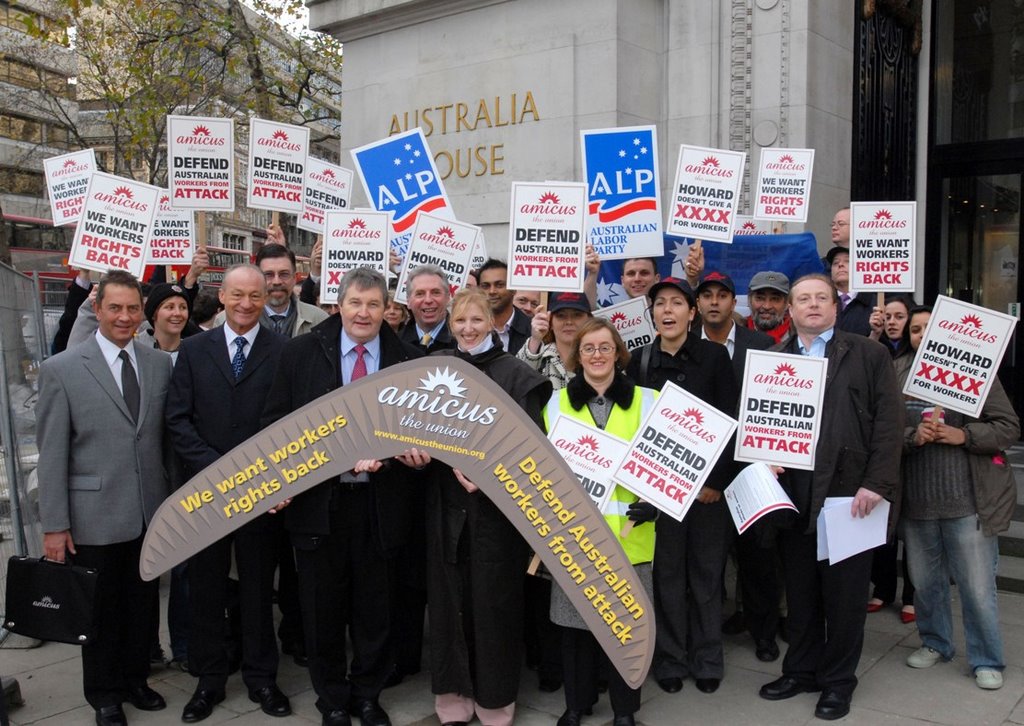
On November 30th trade unionists and activists from Amicus, GMB, Unison and the Australian Labor Party (ALP Abroad) gathered outside Australia House to show solidarity and support for the rallies being held across Australia.
These rallies are part of a long running community campaign coordinated by the Australian Council of Trade Unions (ACTU) against the Howard Government's industrial relations attacks.
The Howard Government forced the radical changes through without any mandate from the Australian public, dismantling the working conditions of Australian workers that have been established over the past 100 years (the changes themselves warrant their own longer post which is coming).
The last thing I'll say for now is that it was pleasing to see UK trade unions looking beyond Europe and the US, and showing their support for their Australian counterparts, it is very encouraging so a big note of thanks to Amicus.
To find out more check out the Rights at Work site (Your Rights at Work) which has up to date information, examples of how the changes are impacting on Australian workers and lists ways that you can become involved in your workplace and community.
Well here goes nothing, the great leap into cyberspace can't be delayed any longer.
As you can see from my title I'm a proud trade unionist and I plan to use this site to post some thoughts.
However I don't plan to ramble or rant too much, I'll basically try to keep my postings and content limited to when I actually have something worth saying.
Hopefully what I do post (or link to) will generate some interesting debate and feedback.
Until I have enough time to actually post something I'll sign out now and start working on building links and content.
Until then, yours in union,
Eamon.